Most ingredient guides tell you what a plant is and what it is thought to do. This one is organised around a different question, because it is the one that decides whether any of the rest matters: what does this compound need in order to get from the capsule into you?
Answered honestly, that question sorts six ingredients into three groups — the ones that depend on your breakfast, the one that depends on the extract specification, and the ones that largely look after themselves.
Group one: the two that depend on your meal
Marigold extract, supplying lutein and zeaxanthin. Lutein is hydrophobic, so it cannot dissolve in the watery contents of the small intestine unaided. It needs bile salts, and bile is released in response to dietary fat. With a fat-containing breakfast it is packaged into micelles and crosses the gut wall; with black coffee a large share continues onward unused.
It then does something none of the other five do: rather than circulating and clearing, it deposits into neural tissue and accumulates over months. That slow second stage is why these products are judged across a season rather than a fortnight.
Evidence: the strongest of the six. A twelve-month randomised trial in older adults taking 12 mg daily reported gains in complex attention and cognitive flexibility, with macular pigment measurements confirming the compound arrived where expected. Fifty-one analysable participants, so a small study with a plausible mechanism behind it.
Turmeric extract, supplying curcuminoids. The same solubility problem and then two more on top. What dissolves crosses the intestinal wall poorly, and what crosses is conjugated rapidly by the liver on first pass. The result is that a generous milligram figure can correspond to very little circulating compound.
Food closes part of that gap and nothing closes all of it. This is the ingredient where the form on the label matters most.
Evidence: promising and narrow. An eighteen-month trial in forty non-demented adults aged 51 to 84 reported improvement on verbal memory and attention measures — using a bioavailability-enhanced preparation, a detail that does not transfer to ordinary extract.
Group two: the one that depends on the specification
Ginkgo Biloba extract. Absorption here is reasonable. The variable sits earlier in the chain: whether the extract was standardised at all.
A leaf is not a consistent raw material. Harvest, drying and extraction all move the concentration of active compounds, so a bare weight on a panel describes how heavy the contents are and not how strong. A standardised extract — conventionally 24% flavone glycosides and 6% terpene lactones — is what makes one batch comparable to the last and to the published trials, nearly all of which used that specification.
Evidence: the largest body of research in this category and the most internally divided. A six-week trial in 188 healthy adults aged 45 to 56 on 240 mg daily found better recall of appointments, and no advantage on recognition tasks in the same study. Two large multi-year prevention trials found no reduction in dementia incidence. All of those results are real.
Worth raising with a doctor: ginkgo affects platelet function and bleeding time. Anyone on anticoagulant or antiplatelet medication should check before starting, and it is usually paused a week or two before scheduled surgery.
What people are searching for when they search Ginkgo
Ginkgo Biloba for memory support is the phrase that brings most people here, and close behind it come Ginkgo Biloba for cognitive support, Ginkgo Biloba for focus and Ginkgo Biloba for mental alertness. They are four ways of asking one question, and the research answers them unevenly.
The strongest finding concerns free recall over a six-week course. Attention measures have been examined with more mixed results, and anyone looking at Ginkgo Biloba for healthy aging should know that the two large prevention trials found nothing. Ginkgo Biloba circulation support is the oldest and most consistent framing, and it is the one the mechanism actually describes.
If you are weighing a standalone Ginkgo Biloba supplement against a combination, the standalone is cheaper and narrower. A Ginkgo Biloba memory supplement at a researched dose does one thing; the argument for a Ginkgo Biloba brain supplement sitting alongside five other actives is coverage across several pathways from one capsule rather than greater potency from this one.
Group three: the three that look after themselves
Green tea extract. Catechins are water-soluble and absorb without needing a meal to help them. What arrives alongside is a small amount of naturally occurring caffeine — far below a cup of coffee — and the L-theanine the leaf pairs it with.
Evidence: good for short-term attention, thin for the long term. The caffeine and L-theanine combination has been examined directly and produced measurable short-term effects on attention and reaction time, distinct from caffeine alone. Those are acute studies measuring hours, and whether daily intake contributes across years is not established.
Bamboo extract. The richest plant source of bioavailable silica, with flavonoid antioxidants alongside. Silica is not fat-dependent and absorbs adequately in the soluble forms used in supplements.
Evidence: reasonable for connective tissue, which includes vessel walls, and close to absent for cognition specifically. We have not found human research on bamboo and cognitive outcomes that would honestly support a claim, so there isn't one here. It is a supporting ingredient.
D-Glucosamine sulfate, stabilised with potassium chloride. The one that is not a plant extract — an amino sugar the body makes naturally. The potassium chloride is a stabiliser for shelf life, not a second active. Water-soluble, absorbed without difficulty.
Evidence: indirect. A prospective study of 466,039 UK Biobank participants associated habitual use with lower cardiovascular event rates, and cardiovascular and cognitive health track together closely. That is a reasonable line of reasoning, not a trial on memory, and no such trial exists.
Worth checking: glucosamine is sometimes shellfish-derived. Confirm the source if you have a shellfish allergy, and mention it to your doctor if you manage diabetes.
Buying these ingredients separately
Each of the six is sold on its own, and sometimes that is the better purchase. A green tea extract supplement is bought for antioxidant coverage as often as for green tea extract cognitive support, and the claims made for green tea extract for focus and green tea extract mental alertness both trace back to the caffeine and L-theanine pairing rather than to the catechins. A marigold extract supplement is usually marketed for eyes rather than for the brain, which is where most of its research originally sat.
The case for a brain supplement with lutein and green tea extract together, alongside four more actives, is coverage in one capsule rather than four bottles and four habits. That is a convenience and adherence argument, and it is worth stating as one — anyone wanting a single ingredient at a researched dose will generally pay less buying it alone.
A word on format while we are here: capsules vs gummies for brain health is a real trade-off rather than a preference. Gummies win on the likelihood you finish the bottle and lose on dose, sugar and stability, and a gummy you take beats a capsule you do not.
What the grouping tells you
Two ingredients hang on your breakfast. One hangs on the manufacturer's extract specification. Three are relatively forgiving. That is a more useful map than a list of six plants with six benefit claims attached, because it tells you where your own behaviour changes the outcome and where it does not.
It also makes the uneven evidence visible. Lutein is the best supported. Ginkgo has the most data and the most disagreement. Turmeric and green tea are promising and limited in different directions. Bamboo and glucosamine are supporting players. A formula is easier to judge when someone says which is which.
Reading the VapoCept label without the marketing
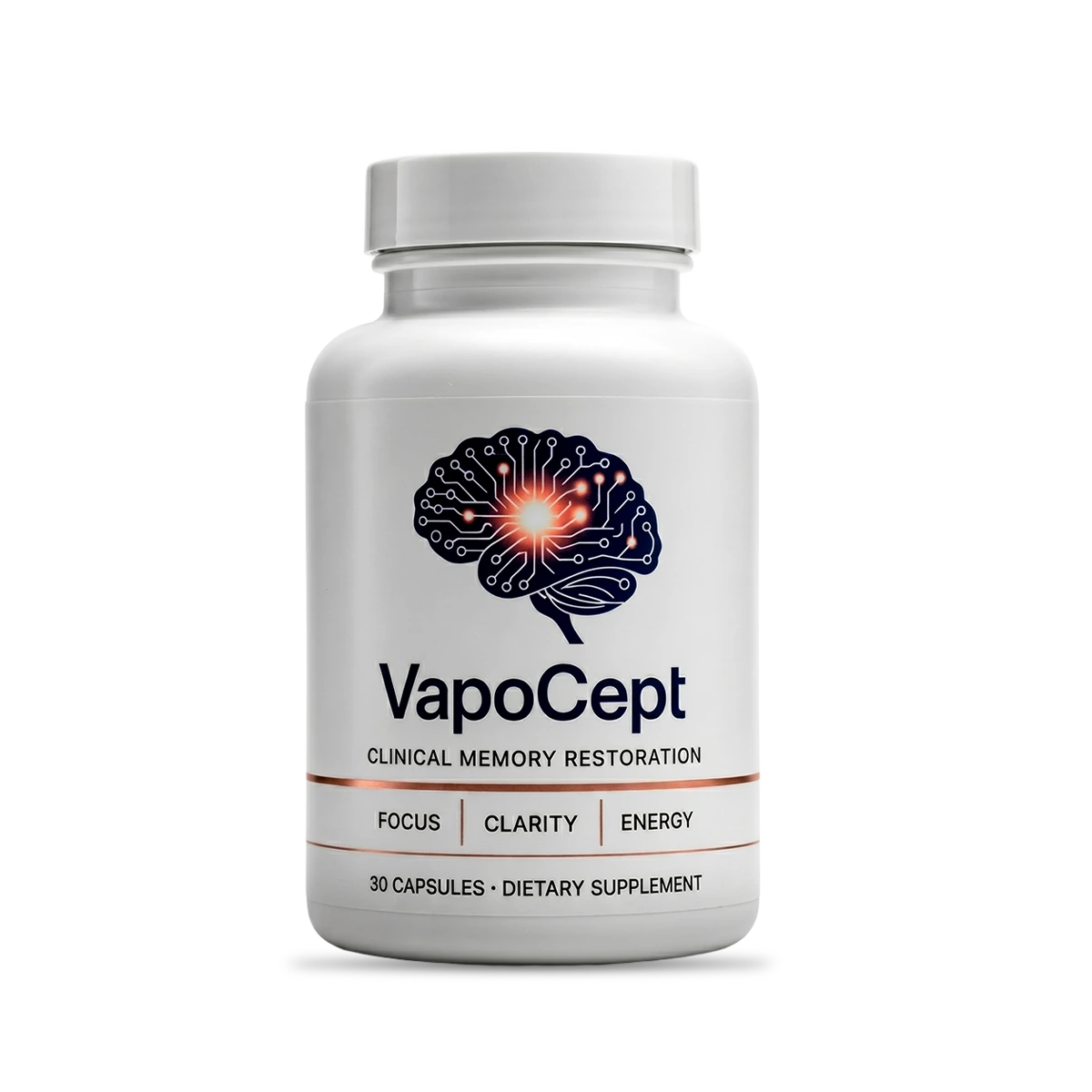
The VapoCept bottle label carries six actives and three inactives, and the VapoCept supplement facts panel prints an amount beside each active rather than pooling them. That is the whole of what a VapoCept label review needs to establish, and it takes about a minute.
A point of recurring VapoCept ingredient confusion is worth settling here. The VapoCept current formula contains five plant extracts plus D-Glucosamine, which is an amino sugar. Describing it as six botanicals is therefore inaccurate, and anyone comparing a VapoCept botanical formula against a VapoCept amino acid formula is comparing two descriptions of the same bottle. VapoCept lutein comes from the marigold extract; VapoCept green tea extract supplies the catechins; VapoCept bamboo extract supplies silica; VapoCept D-Glucosamine is the non-plant component.
If the VapoCept formula changed at some point, the panel on the bottle in your hand is the authority, not any page describing it — this one included.
The three inactive ingredients
Bovine gelatin capsule. Dissolves readily in stomach acid, releasing the contents early enough to meet your meal in the small intestine. Being cattle-derived protein, it puts the product out of reach for anyone eating vegetarian or vegan, and no halal or kosher certification is held. Of everything on this page, that is the detail most likely to rule the product out.
Magnesium stearate. A flow agent that keeps powder moving through encapsulation machinery without sticking, which is what makes consistent fill weights — and therefore consistent doses — possible. A few milligrams per capsule.
Microcrystalline cellulose. Purified plant fibre used as a bulking agent so each capsule holds the same volume. Inert and plant-derived.
The formula questions people ask most
What are VapoCept's real ingredients? Six actives and three inactives, printed on the panel. VapoCept turmeric extract, VapoCept marigold extract, VapoCept green tea extract, VapoCept bamboo extract and the VapoCept Ginkgo formula component are the five plant extracts; VapoCept D-Glucosamine is the sixth active and is not a plant. That makes it a VapoCept six-ingredient formula, which is the accurate description.
Has the formula changed? Questions about VapoCept old formula vs new formula come up because several descriptions of this product circulate online, some of them out of date. The VapoCept current supplement facts on the physical bottle are the only authority worth trusting. If what you read somewhere does not match the panel in your hand, believe the panel.
What are the pros and cons? The VapoCept pros and cons are not complicated. In its favour: every active named with an amount, a once-daily format people actually finish, and two ingredients with genuine randomised support behind them. Against it: a gelatin shell that rules out several diets, two ingredients with little direct cognitive evidence, and a timeline measured in months. A VapoCept formula review that lists only the first set is not a review.
A VapoCept formula comparison against other products is covered on the price page, and a VapoCept label explained line by line is what this page has been doing throughout.
Why there is no proprietary blend
A blend reports several ingredients under one combined weight. It is legal and common, and it makes it impossible to tell whether something is present at a research-relevant amount or as a trace added so the name can appear on the front.
With all six listed separately you can check each against your medication list, hand the panel to a pharmacist, and compare amounts against the studies above. None of that guarantees an outcome. It does mean the questions on this page are answerable at all.
See price & packages